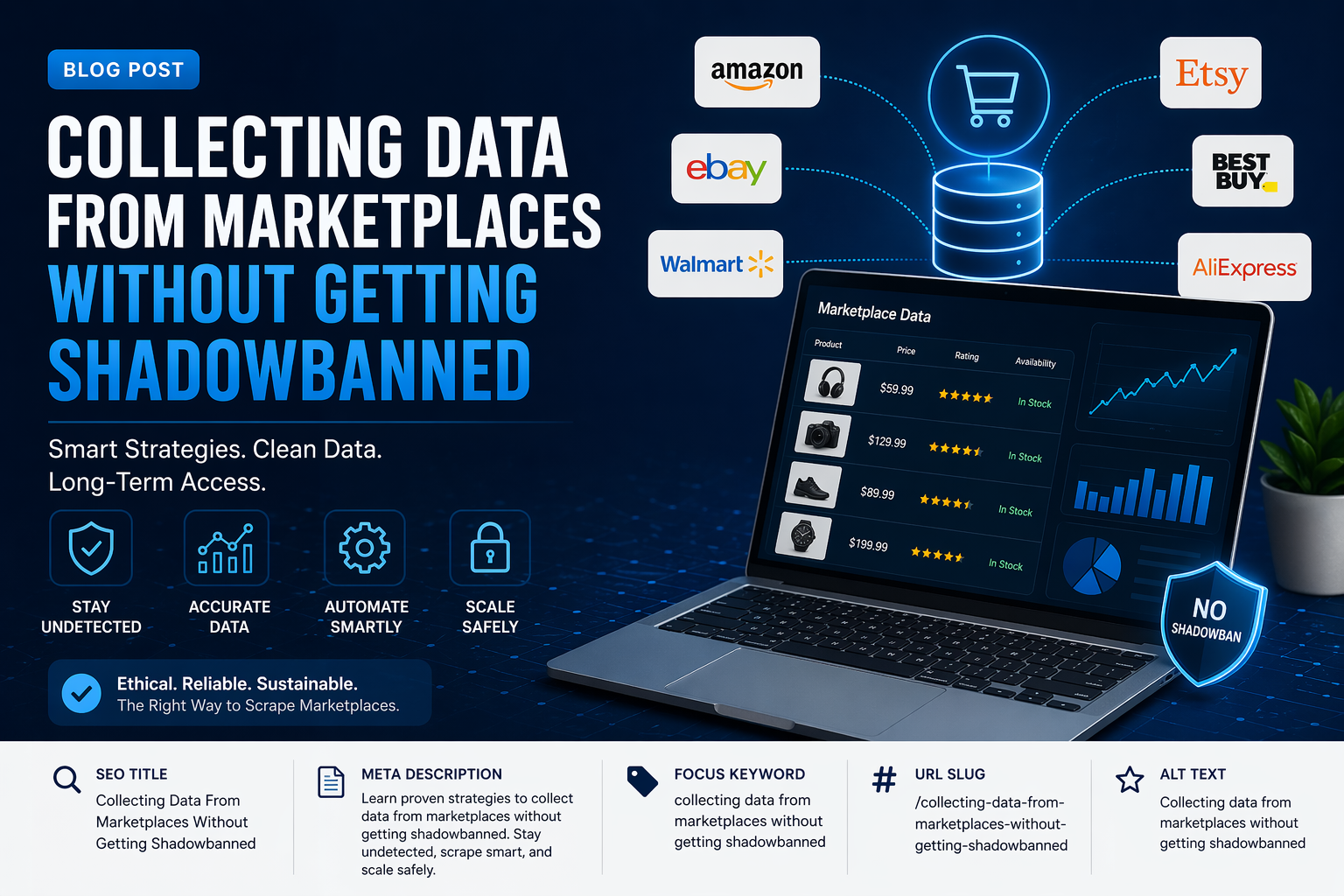
Modern marketplaces run on data. Sellers track competitors, brands monitor unauthorized listings, analysts benchmark pricing, and growth teams look for new opportunities. But marketplaces also aggressively protect their platforms. If you collect data the wrong way, you can be throttled, silently blocked, or shadowbanned – where everything looks normal from your side, but the data you receive is limited, distorted, or missing.
This article is a practical guide to collecting data from marketplaces in a way that minimizes your chances of being detected or shadowbanned. It focuses on technical strategies, behavior patterns, and infrastructure design, with concrete tactics that apply to most modern e‑commerce and service marketplaces.
What Shadowbanning Looks Like on Marketplaces
Shadowbans are often more dangerous than hard blocks because they are silent. Instead of being greeted by a blunt error page or CAPTCHA wall, you get a degraded version of the site. Common signals include:
- Search results that suddenly return fewer items than expected.
- Product, seller, or listing pages that intermittently return 404 or generic error pages.
- Normal browsing in the browser, but reduced data when hitting the same endpoints from your scripts.
- Rate limits that trigger much earlier than usual for a particular IP or account.
Marketplaces do this to slow down automated data collection, learn your patterns, and avoid tipping off scrapers that they’ve been detected. The first step in avoiding shadowbans is understanding the signals that your scraping or integration strategy is already being profiled.
Core Principles for Safe Marketplace Data Collection
Every marketplace has its own detection stack, but the underlying ideas are similar. To stay under the radar, you must look and behave like a large, diverse population of legitimate users rather than a single focused bot. That boils down to four principles:
- Control your identity surface – IPs, fingerprints, and accounts.
- Control your behavior – timing, navigation paths, and request mix.
- Control your footprint – volume, density, and locality of requests.
- Continuously measure – detect early signs of throttling or shadowbans.
Respect Legal and Platform Boundaries First
Before touching any technical details, you should understand the legal and ethical context of data collection:
- Review the marketplace’s terms of service. Some explicitly forbid automated access or scraping; others allow certain usage patterns or provide official APIs.
- Prefer official APIs where available. They provide stable access, predictable quotas, and usually fewer compliance risks.
- Avoid collecting personal data unless you have a lawful basis. Many regulatory regimes (e.g., GDPR, CCPA) significantly restrict how personal data can be collected, stored, and processed.
- Use data defensively. Competitive intelligence, compliance monitoring, and brand protection use cases are far easier to justify than abusive or exploitative usage.
The technical strategies in this guide are intended to help legitimate businesses gather data more reliably, not to bypass laws or engage in abusive scraping.
How Marketplaces Detect and Shadowban Automation
To avoid detection, you need a mental model of how marketplaces identify automated traffic. Detection generally combines several layers:
1. Network and IP Signals
- Repeated high‑volume traffic from a single IP or subnet.
- IPs known to belong to data centers or cloud providers.
- Traffic coming from geographic regions that don’t match the user profile or marketplace audience.
2. HTTP and Browser Fingerprints
- Simplified or inconsistent HTTP headers.
- User‑agents that are too generic or clearly outdated.
- Missing capabilities like JavaScript, cookies, or local storage when the normal site requires them.
- Canvas, WebGL, and font fingerprints that look synthetic or repeated across many sessions.
3. Behavioral Patterns
- Perfectly regular request intervals (e.g., exactly every 1,000 ms).
- Non‑human navigation flows: hitting deep product URLs without visiting category or search pages.
- Unusually high coverage – for example, visiting almost every seller in a category.
- Excessive search queries with trivial variation.
4. Application‑Level Traps
- Triggering hidden URLs only seen by bots.
- Ignoring anti‑automation JavaScript challenges.
- Failing to complete subtle flows, such as scrolling or interacting with UI elements.
Shadowbans are often applied when these signals cross a certain risk threshold without being egregious enough for a full block. Your goal is to keep each signal below that threshold.
Designing a Scraping Strategy That Looks Like Normal Users
Instead of thinking in terms of raw throughput, think in terms of simulating a population of users. This shift in mindset is what typically separates sustainable data collection from short‑lived scraping bursts.
Distribute Requests Across Many IPs
Relying on a handful of data center IPs is one of the fastest routes to a shadowban. To marketplaces, this looks nothing like real user traffic. Instead:
- Use a wide pool of residential IPs that come from real consumer networks. This aligns your network signature with actual shoppers and significantly reduces the chance of being classified as bot traffic.
- Choose IPs from the same regions where your marketplace operates. For example, if a marketplace is primarily US‑based, prioritize US residential IPs.
- Limit the number of requests per IP per hour or per day to stay close to normal browsing behavior.
Providers like ResidentialProxy.io are built specifically for this: they offer large, rotating pools of residential IPs, which help you distribute your traffic in a way that resembles organic user activity rather than centralized scraping.
Rotate Identities, Not Just IPs
Marketplaces increasingly correlate traffic using more than just your IP address. To further diffuse your identity:
- Rotate user‑agents to simulate different devices and browsers.
- Create distinct cookie jars or sessions so that each simulated user maintains a consistent state.
- Vary accepted languages, screen resolutions, and time zones within realistic ranges.
- Avoid reusing the exact same fingerprint across hundreds of IPs.
Slow Down and Randomize Timing
Human behavior is messy. Bots tend to be regular. To stay safe:
- Introduce random delays between requests, not fixed intervals.
- Model your crawl rate on real user patterns, with peaks during normal shopping hours.
- Use concurrency carefully – many lightweight sessions are better than a few extremely heavy ones.
Emulate Natural Navigation Flows
Marketplaces expect users to search, filter, scroll, and then click into detail pages. Your crawler should mimic this path:
- Start from category or search pages, not only from specific product URLs.
- Follow pagination instead of hitting deep pages via artificially constructed URLs only.
- Mix in some non‑critical pages (home page, category overview, help pages) like a normal user would.
- For client‑heavy sites, simulate basic interactions such as scrolling or clicking tabs.
Building a Technical Stack That Minimizes Shadowbans
The right infrastructure makes it much easier to enforce good behavior at scale. A typical anti‑shadowban stack for marketplace data collection has these pieces.
1. Proxy Layer: Residential, Carefully Managed
Your proxy provider is one of the most critical choices. Using residential proxies helps you:
- Blend into real consumer traffic patterns.
- Access geo‑locked content or region‑specific prices and listings.
- Avoid most of the automatic data center IP blocks.
With a provider like ResidentialProxy.io, you can:
- Rotate residential IPs on a schedule or per request, depending on the sensitivity of the marketplace.
- Choose specific countries or regions to match marketplace localization.
- Enforce per‑IP rate limits in your application, since the proxy gateway handles the heavy lifting of IP management.
2. Session and Identity Management
Implement a dedicated session manager that tracks each logical “user” in your system:
- Assign each session an IP (via proxy), a user‑agent, and a cookie jar.
- Keep sessions alive for a realistic duration (e.g., tens of minutes to several hours).
- Rotate sessions gradually, not all at once, to avoid suspicious resets.
3. Rate Limiting and Scheduling
A centralized scheduler should enforce limits:
- Set per‑IP, per‑session, and global request ceilings.
- Stagger high‑intensity tasks across time and geography.
- Temporarily back off when error rates spike or responses degrade, which can be a sign of soft blocking.
4. Headless Browsers vs. HTTP Clients
For some marketplaces, a lightweight HTTP client with good header and cookie handling is enough. For others, you may need headless browsers:
- Use HTTP clients when pages are mostly server‑rendered and don’t rely on complex JavaScript.
- Use headless browsers when you need to execute JavaScript, pass browser fingerprint checks, or deal with dynamic content loaded via client‑side APIs.
Headless browsers should still go through your residential proxy layer to avoid concentrated traffic from data center IPs.
Marketplace‑Specific Scraping Patterns
Different marketplace models call for slightly different collection strategies.
Product Marketplaces (Retail, C2C, B2B)
When scraping product marketplaces:
- Focus on search result and category pages as your primary index.
- Use incremental crawls – fetch new products or updated listings instead of full recrawls every time.
- Be careful with price alerts or rapid‑fire refreshes of the same product page; spread checks over time.
Service Marketplaces (Freelance, Local Services)
For service‑based marketplaces:
- Query realistic combinations of filters (location, category, price range) instead of exhaustive permutations.
- Limit how many profiles you visit from a single search query to resemble real browsing.
- Watch for aggressive profile‑view counters or rate‑limited profile requests.
Booking and Rental Platforms
These platforms often have strong anti‑automation measures due to pricing sensitivity:
- Throttle date‑range variations to avoid generating an explosion of permutations.
- Distribute checks for the same listing ID across different days and IPs.
- Respect availability caching – if the same listing is unlikely to change, don’t hit it repeatedly.
Monitoring for Early Signs of Shadowbanning
Ongoing monitoring is your insurance policy. Even with best practices, detection systems can change suddenly.
- Track response codes by IP and session. Sudden spikes in 429, 403, or 5xx errors can indicate rate limiting or shadow throttling.
- Compare data volume and diversity over time. If search results shrink or certain categories become under‑represented, you may be seeing partial shadowbans.
- Build canary scripts that fetch a known set of pages with a low frequency. If they start failing or returning fewer items, pause or slow the main crawl.
- Log marketplace hints like unexpected captchas, additional login prompts, or new JavaScript challenges.
Recovery Strategies After a Shadowban
If you suspect your infrastructure has been shadowbanned on a marketplace, rushing forward with more traffic usually makes things worse. Instead:
- Pause the affected IPs and sessions. Remove them from active rotation and lower your global crawl rate temporarily.
- Audit behavior leading up to the issue. Look for spikes in volume, pattern changes, or new endpoints you started hitting.
- Introduce stricter limits for that marketplace: lower per‑IP requests, greater randomization, longer delays.
- Slowly ramp back up with new IPs and altered navigation patterns, measuring response quality closely.
A large, flexible proxy pool (such as the one provided by ResidentialProxy.io) helps with recovery: you can remove suspect IPs, adjust geographic mix, and reintroduce traffic in a controlled way without discarding your entire infrastructure.
Practical Checklist for Marketplace Scraping Without Shadowbans
To summarize, here is a compact checklist you can use when designing or reviewing your marketplace data collection setup:
- Use residential proxies from relevant regions; avoid direct data center IPs.
- Distribute load across many IPs with strict per‑IP request limits.
- Rotate user‑agents and maintain realistic, stateful sessions (cookies, local storage).
- Randomize timing and avoid robotically regular request intervals.
- Emulate typical navigation flows: search → browse → detail pages.
- Use incremental crawls and avoid full recrawls without clear need.
- Continuously monitor response codes, result counts, and error rates per IP.
- Back off and adjust when you detect early signs of throttling or data degradation.
Closing Thoughts
Sustainable marketplace data collection is less about raw scraping power and more about subtle mimicry of real users. By controlling your identity surface with residential proxies, shaping your behavior to match human browsing patterns, and monitoring for early warning signals, you can significantly reduce the risk of shadowbans while building a reliable data pipeline.
If you need a robust residential proxy layer to support this strategy, consider exploring ResidentialProxy.io. The combination of a large, geo‑distributed pool of residential IPs and careful behavioral design will give you the best chance of collecting marketplace data safely, consistently, and at the scale your business needs.